 16 hours ago
4
16 hours ago
4
France's gambling regulator ordered internet service providers to block access to Polymarket, the crypto prediction-market platform, escalating beyond a transaction geofence that it said had been circumvented in practice.
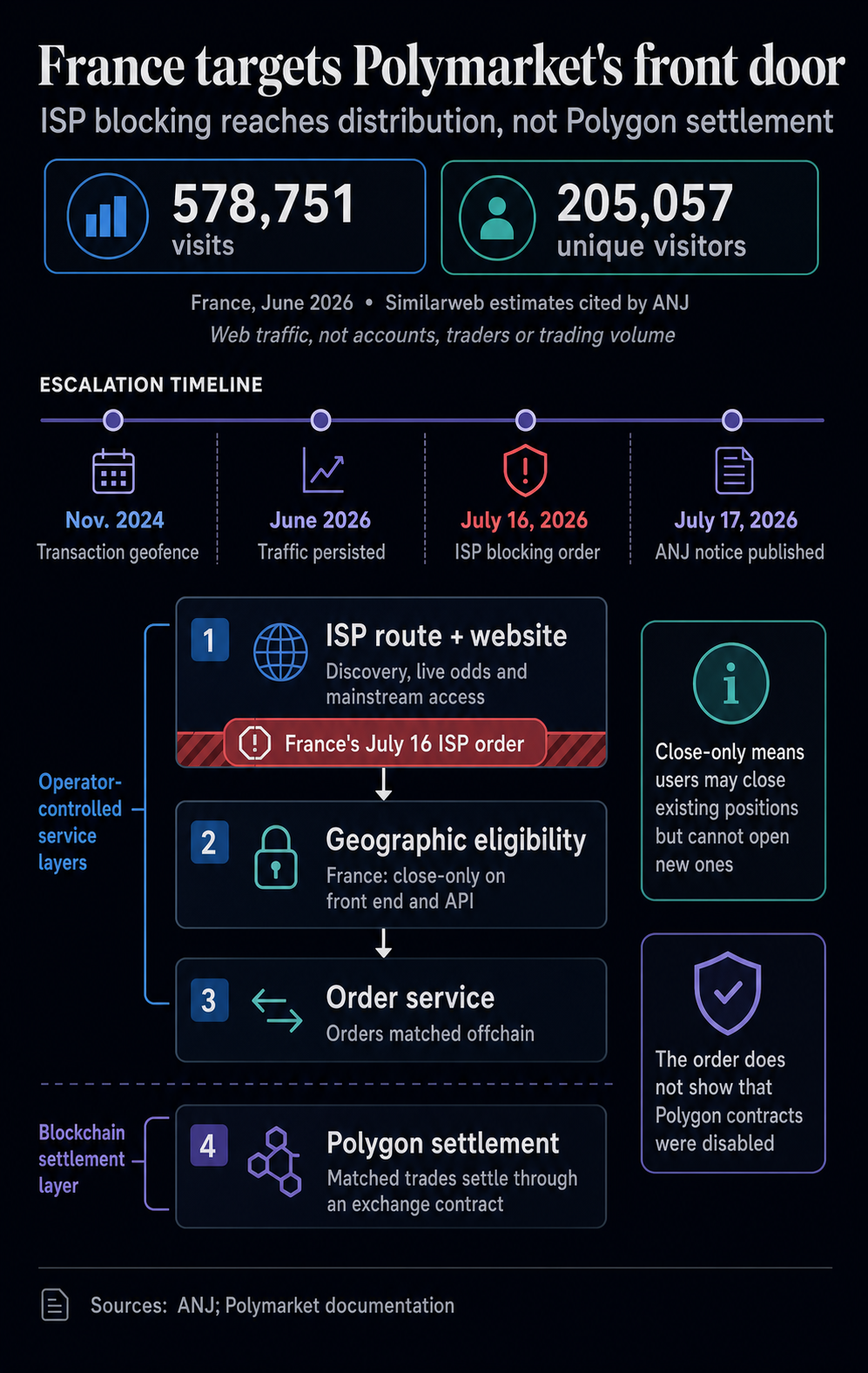
The Autorité nationale des jeux published the order on July 17, arguing that Polymarket's website promoted an unauthorized gambling offering even where the earlier restriction was meant to stop financial transactions from France. The regulator said, citing Similarweb, that the site drew 578,751 visits and 205,057 unique visitors from France in June 2026.
Those figures help explain why France moved from asking the operator to restrict transactions to directing the country's access providers to close the main website.
The escalation also exposes a crucial limit to the idea that an onchain market is beyond national reach: settlement can occur on a blockchain, while mainstream users still depend on the website and operator-controlled systems to discover markets and submit orders.
A geofence that did not end the audience
The escalation was not France's first intervention. In November 2024, the ANJ said it had approached Adventure One QSS Inc., the Panamanian company it identified as Polymarket's operator, after concluding that the platform's services could qualify as unauthorized gambling under French law. Adventure One then installed a geoblock that the regulator initially described as preventing bets from France.
The ANJ's July 2026 notice framed the new order as the next step in that same case. It said the earlier control prevented financial transactions from French territory but led to workarounds in practice. The Polymarket homepage nevertheless continued to display live odds to a large French audience.
A control that rejects new transactions may reduce direct participation while leaving the site's role in attracting users and circulating betting prices intact. The ANJ said the homepage's dynamically updated odds made it a major channel for promoting an activity it considers illegal.
French law gives the regulator a route to act against that interface. After statutory notice and response periods, Article 61 allows the ANJ to order access providers to prevent access to specified illegal online interfaces and to require search engines or directories to stop referencing them. The regulator said it blocked 1,290 URLs associated with illegal gambling in 2025 using this process.
The result is a wider distribution sanction. Instead of relying on the platform to decide which transactions to reject, France can pressure the domestic networks and discovery services that connect a mainstream audience to the platform.
The ANJ has grounded its case in gambling law rather than the use of cryptocurrency. Its 2024 notice said the intervention concerned the broader gambling character of the offering.
Its February 2026 policy statement expanded that rationale. The regulator classifies prediction markets as unauthorized gambling in France and says they combine continuous access and viral distribution with fewer protections than licensed operators. It cited addiction and integrity risks, along with absent identity and age checks, as reasons for restricting access.
The regulator's arguments show why an odds-displaying homepage is not neutral in its view. Live prices function as product marketing, while the identity, age-control and integrity systems around the market determine whether authorities see it as an acceptable service for local users.
The block reaches the service, not the Polygon contracts
Polymarket's own documentation makes the line between distribution and settlement unusually clear. Its current geographic restrictions page lists France as close-only on both the front end and API. Users in that category may close existing positions but cannot open new ones. The platform hosts its IP eligibility check on polymarket.com, showing that geographic access is enforced through infrastructure the operator controls.
At the same time, Polymarket describes its central limit order book as a hybrid system. Orders are matched off-chain, while matched trades settle atomically through an exchange contract on Polygon. Trading is non-custodial, according to the platform.
France's order targets access to the website and its service interface, not Polymarket's separate Polygon settlement layer. Nothing in the order indicates that France disabled the contracts. Its practical leverage instead concentrates on the layers that make the product usable and discoverable for ordinary customers.
Reaching a broad audience depends on a recognizable front end, reliable order submission, off-chain matching, geographic eligibility checks, and a compliance posture that lets users and distribution partners interact with the product.
An ISP block interferes with that commercial path. On-chain settlement does not make distribution permissionless: the front door remains where a national regulator can exert leverage.
Europe's response remains a patchwork of national actions rather than a single EU-wide ban. The ANJ identified 12 European jurisdictions that it said had restricted or blocked prediction markets: Germany, Belgium, Romania, Switzerland, Poland, the Netherlands, Greece, Italy, Portugal, Spain, Ukraine and the Czech Republic.
The actions differ by jurisdiction. Spain offers one recent example. On May 26, 2026, the country's Directorate General for Gambling Regulation ordered the Polymarket and Kalshi websites to be blocked as an interim measure while it pursued proceedings regarding possible unlicensed gambling operations. Spain's regulator highlighted licensing, identity verification, access controls for minors, and self-exclusion protections.
That patchwork creates a difficult operating choice for prediction markets. Stronger geographic gating may reduce immediate regulatory exposure, but France's experience suggests a transaction-only restriction may not satisfy authorities that view the visible odds and audience reach as part of the gambling offer.
More extensive identity checks and consumer protections could answer some concerns, while licensed entry would require the platform to fit national legal categories that may differ across borders.
The near-term test centers on whether Polymarket changes its front-end controls, regulatory posture or distribution model enough to preserve mainstream access as more European jurisdictions classify prediction markets as gambling.
France has shown where its leverage lies. A regulator doesn't need to alter an on-chain market's settlement logic if it can make the website harder to reach and raise the compliance cost of serving a national audience through operator-controlled access and distribution layers.