 8 hours ago
1
8 hours ago
1
Trump Media is turning Truth Social posts into a feed for traders, and prediction markets now face a timing problem.
The issue is what happens after a post becomes public but before most users can see, read, and act on it.
On July 17, the Financial Times reported that Trump Media discussed charging traders up to $100,000 per month for faster access to President Donald Trump’s Truth Social posts.
The report followed Trump Media’s July 16 announcement of Truth API, a licensed feed scheduled for an Aug. 1 launch. The company said the product will cover 10 influential accounts, operate around the clock, and deliver posts faster than Truth Social push notifications.
Trump Media said algorithmic trading firms, banks, and other organizations that bear the cost of information delays are the target market.
The Financial Times reported a monthly price as high as $100,000, though other reports said the figure lacked independent verification. Trump Media also said customers had already signed up, positioning the feed as its first data-licensing business and a new revenue line.
That creates a different market-design problem from the ongoing Gabriel Perez case.
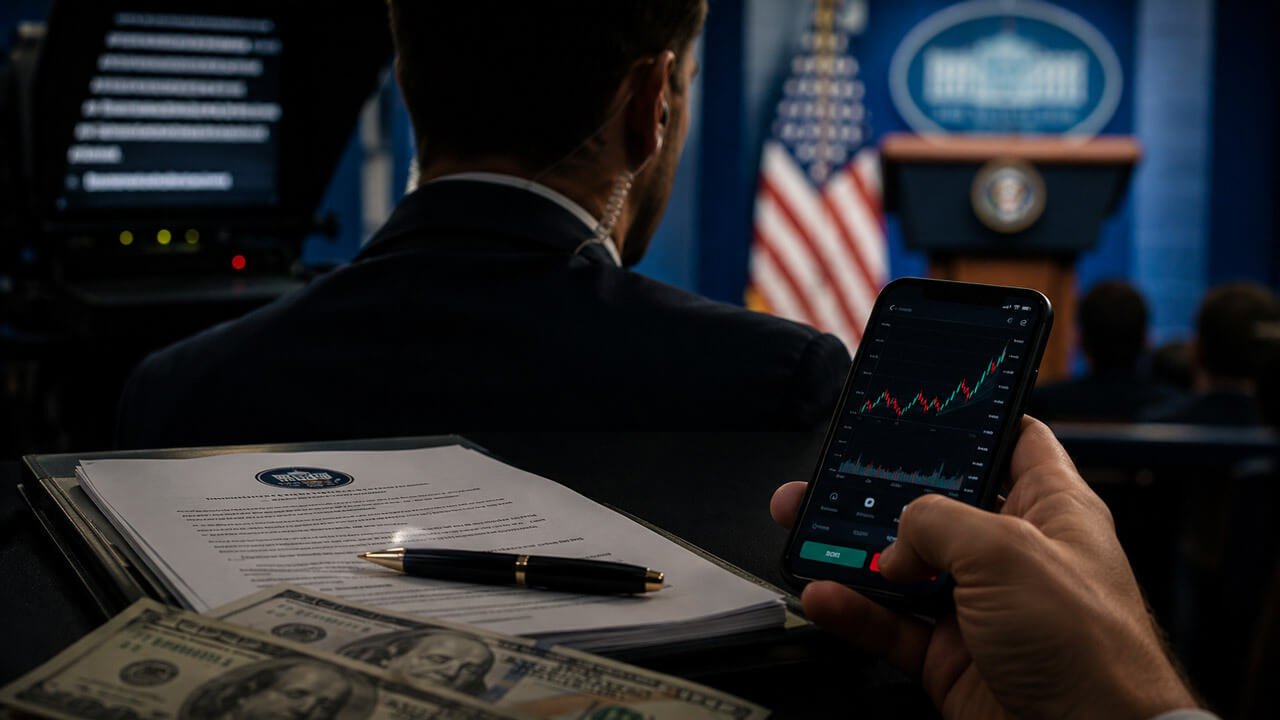
Perez, President Donald Trump’s longtime teleprompter operator, faces a Commodity Futures Trading Commission (CFTC) investigation over wagers on Kalshi contracts that tracked Trump’s speeches. Investigators allege that Perez used access to prepared remarks before Trump delivered them, allowing him to trade in Kalshi “mention markets” before other participants knew what Trump would say.
Kalshi froze his account before he withdrew over $90,000 in profits, referred the activity to the CFTC, and provided evidence from its onboarding and surveillance systems across more than a dozen Trump speeches.
Perez has cooperated with regulators, and the CFTC has declined public comment.
The Perez case centers on alleged access to information before publication. Truth API centers on speed after publication.
Either route can push a prediction contract from forecasting toward capturing an answer that one participant already knows or can process before most users.
| Information edge | Alleged access before Trump spoke | Faster access after Trump posts |
| Information status | Nonpublic prepared remarks | Public post, faster distribution |
| Market risk | Trader may know the outcome before others | Trader may process the outcome before others |
| Legal / platform issue | Insider-style misuse of confidential information | Paid latency advantage |
| Best response | Insider restrictions, KYC, surveillance, CFTC referral | Timestamp rules, automatic halts, post-publication trade reviews |
| Why it matters | Forecasting becomes trading on a known answer | Forecasting becomes a speed race after publication |
Two clocks govern the trade
Kalshi’s rulebook bars people who possess material nonpublic information and people who can influence a contract’s resolution.
Those restrictions place an employee with advanced access to a speech inside a familiar enforcement framework. The CFTC has also told designated contract markets to maintain audit trails, conduct surveillance, and enforce rules against misuse of confidential information.
Truth API creates a separate problem because publication and distribution operate on different clocks.
Trump makes a post public at upload. A machine-readable feed can then transmit and classify it before a retail user receives a notification, refreshes the app, or reads the text.
Political event contracts sharpen that problem because a sentence, word, or policy announcement can settle the economic meaning of a position within seconds.
A contract on whether Trump mentions tariffs during a speech becomes vulnerable once staff can read the prepared text. A contract that tracks a Truth Social announcement can become vulnerable at the instant an API detects decisive language.
That creates a short interval in which trading can continue after a machine has identified the outcome. During that interval, the fastest trader can engage in post-publication arbitrage against participants who still believe they face an unresolved event.
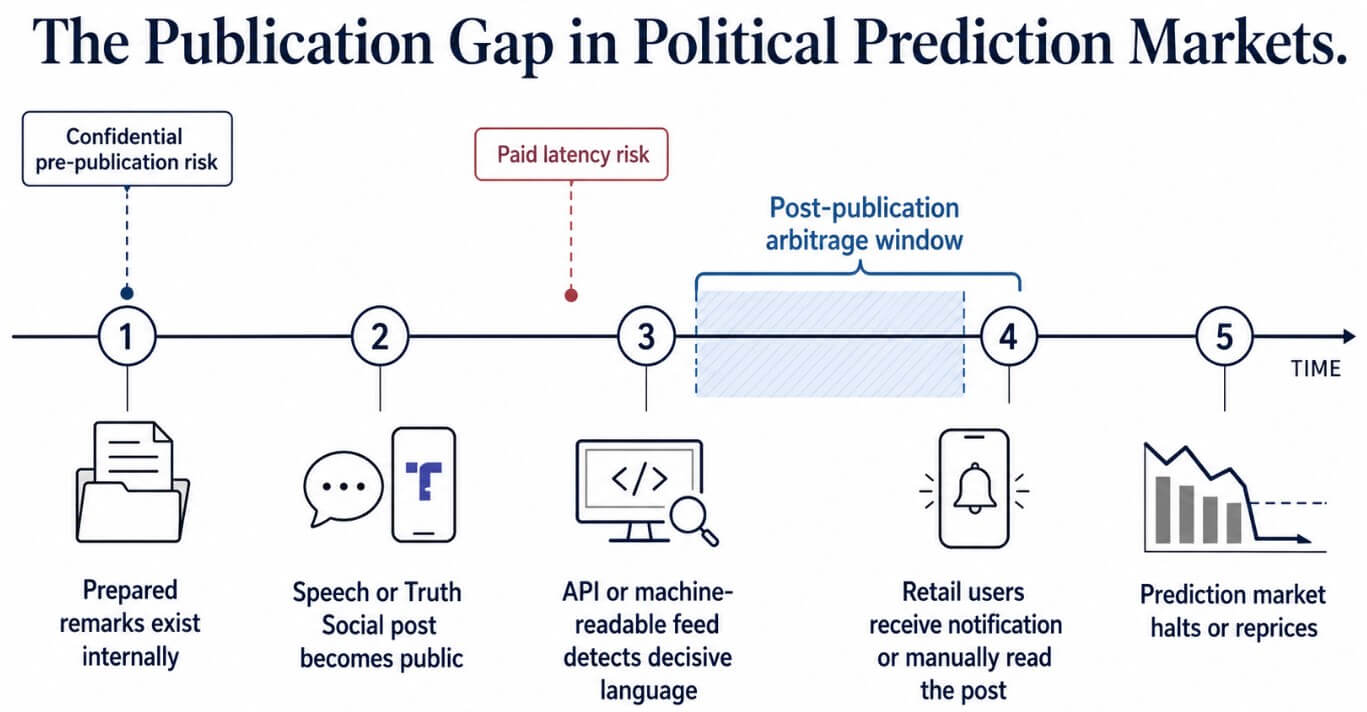 The graphic maps how privileged access and faster feeds can let machines react to political posts before retail users and market repricing.
Trump Media’s ownership adds a political layer to the commercial product, since the Donald J. Trump Revocable Trust holds about 41% of the company’s outstanding shares, and Trump’s children oversee the trust.
Senator Ron Wyden said the feed would benefit the Trump family and Wall Street firms, and Reuters reported that Trump Media left its inquiry about unequal trading opportunities unanswered.
A platform can prohibit a White House employee from using a confidential script, then apply a different set of controls to a hedge fund that buys lawful access to a published post and routes the text into an algorithm.
The publication gap
A venue could close a speech contract before prepared remarks reach production staff, then settle it from an authoritative transcript. That design would reduce live volume while removing the period in which event workers know more than traders.
A venue could also record the authoritative publication timestamp, compare it with every order timestamp, and pause trading once the source releases decisive information. Trades that arrive during a defined detection window could enter review before settlement.
A post may contain ambiguous language, edits, deleted text, or a link whose content supplies the answer. Exchanges would need source archives, synchronized clocks, and rules that explain which timestamp governs resolution.
The CFTC has placed front-line responsibility on exchanges to monitor event contracts and protect market participants from abusive practices.
Kalshi can connect an order to a verified customer, employment disclosure, and account history.
Crypto-native venues face a thinner identity layer. Wallet clustering can connect addresses and funding paths, but a wallet alone cannot show whether its controller works for the White House, bought an API subscription, or runs a fast bot.
Institutional-grade on-chain markets would need stronger identity checks for sensitive contracts, alerts that reference source timestamps, and cross-venue cooperation when related wallets trade on the same political event.
The CFTC has already shown attention to insider access, while Polymarket has pointed to real-time surveillance, investigations and regulatory referrals as part of its market-integrity framework.
Market integrity scenarios
In the bull case, platforms adopt pre-speech cutoffs, automatic source-triggered pauses, and auditable timestamp rules.
Regulated venues add employment disclosures for sensitive contracts, and on-chain operators apply identity checks to high-value political markets. Prices preserve value as forecasts because venues close the publication gap before speed turns resolution into an arbitrage contest.
In the bear case, political markets keep trading through the interval between machine detection and broad human awareness.
More staffers, contractors, and paid-feed customers convert timing advantages into profits across speeches, posts, and policy announcements. Prediction odds then reflect information leakage and latency capture, weakening their use as measures of collective expectations.
| Bull case: publication gap closes | Pre-speech cutoffs, source-triggered pauses, auditable timestamps | Odds remain useful as forecasts | Lower live-trading volume |
| Base case: regulated venues tighten controls | Kalshi-style KYC, employment checks, surveillance and CFTC referrals expand | Trust improves on regulated platforms | On-chain venues remain harder to police |
| Bear case: latency races continue | Markets stay open after machine-readable outcomes appear | Odds reflect speed and leakage, not collective expectations | Users lose trust in political contracts |
| Fragmentation case: liquidity moves on-chain | Traders avoid stricter regulated venues | More activity shifts to wallets and offshore markets | Identity and insider links become harder to prove |
Truth API can operate as a lawful commercial data product, according to a lawyer Reuters interviewed.
Prediction markets now need separate defenses for confidential knowledge and premium-speed public data, because either route can allow a participant to trade an answer that the rest of the market still treats as a forecast.