 2 months ago
68
2 months ago
68
Agentic payment protocol x402 volume collapsed roughly 77% from its November 2025 peak of $5.15 million to $1.19 million by May 2026.
Meanwhile, transaction count fell only 41% from its December 2025 peak of 4.85 million, then rebounded to 2.89 million in May, up 12.5x from a February trough, with an average transaction size of $0.52.
The market's recovery took the form of high-frequency, low-value usage, revealing that agents are paying for APIs, data, and compute over HTTP at sub-dollar amounts, relying on automation to function.
A conservative 5-to-15-second wallet confirmation to each of those 2.89 million monthly x402 transactions can generate between 4,000 and 12,000 user-hours of approval friction in a single month.
At a $25/hour time value, each manual confirmation costs $0.03 to $0.10, which is material for a $0.52 transaction, and economically absurd for a $0.01 API call.
At sub-cent payment sizes, the friction cost exceeds the transaction value itself, and the smaller the payment, the wider that distance.
That logic explains why every major actor building agentic payment infrastructure now concentrates on authorization frameworks.
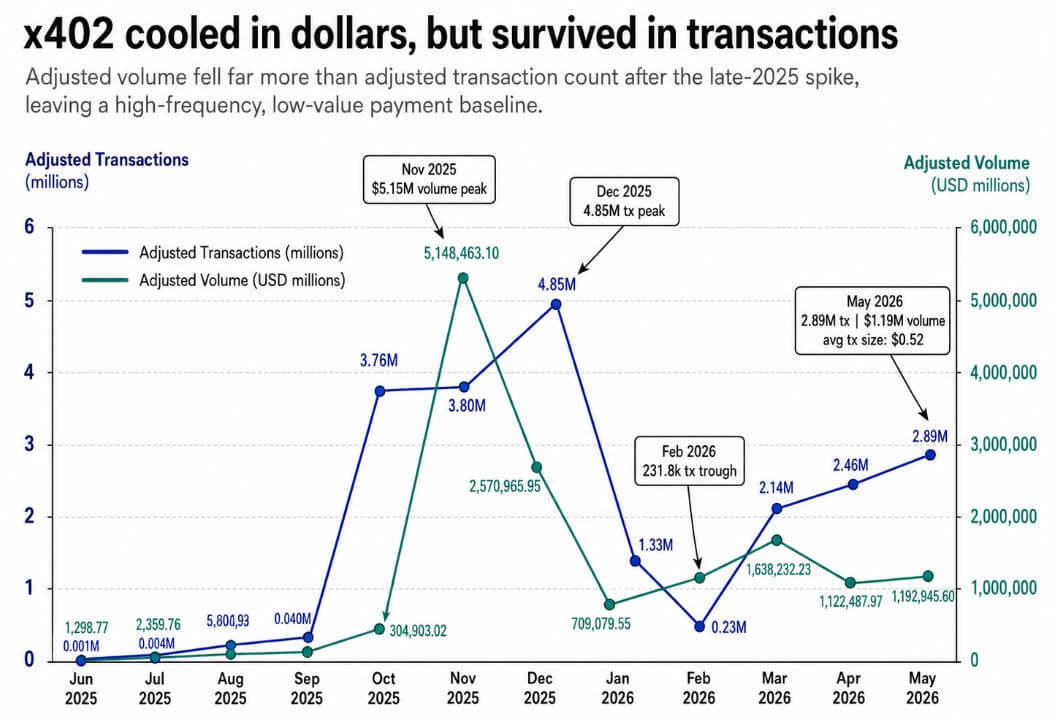 x402 adjusted volume fell 77% from its November 2025 peak of $5.15 million, while transaction count rebounded to 2.89 million by May 2026.
Industry actors building the delegation layer
Google donated AP2 to the FIDO Alliance in April 2026 after developing it as an authorization framework for delegated AI tasks.
AP2 uses cryptographically signed “mandates,” instructions that define what an agent can do, under what conditions, and within what limits.
For tasks where the user is absent, AP2 supports pre-authorized rules that cover price ceilings, time windows, and action scope. Donating it to FIDO pushes it toward a cross-platform standard, and FIDO frames AP2 as enabling secure delegation, verifiable authorization, and trusted transaction execution.
Mastercard's Verifiable Intent creates a tamper-resistant record linking what the user authorized to what the agent executed, an audit trail that travels with the transaction and answers whether an agent did exactly what the user asked and nothing more.
Stripe and Tempo's implementation of the Model Context Protocol for payments addresses the on-chain friction version of the same challenge.
A Tempo Machine Payments Protocol (MPP) session requires only two on-chain transactions, one to open, one to settle, regardless of how many payments occur in between, letting agents execute high-frequency, low-value payments without paying on-chain costs per request.
Stripe's machine payments documentation describes pay-per-use models starting at 0.01 USDC per agent invocation, recurring payments, and programmatic API calls, all designed for agents acting without a human in the loop.
Cloudflare treats x402 and MPP as HTTP infrastructure, with agents discovering services, receiving 402 Payment Required challenges, and retrying with payment credentials programmatically.
Visa's Intelligent Commerce Connect, already in pilot with AWS, Diddo, Highnote, Mesh, Payabli, and Sumvin, adds tokenization, spend controls, and authentication to the same stack.
Across all of these, the common architecture positions authorization at the policy level, where a single user decision governs many agent actions.
| Google AP2 | Signed mandates | Price ceilings, time windows, action scope | Lets agents act under pre-authorized rules |
| Mastercard Verifiable Intent | Tamper-resistant intent record | Whether action matched user authorization | Creates audit trail between intent and execution |
| Stripe / Tempo MPP | Sessions | Many payments inside one open/settle flow | Reduces friction for high-frequency payments |
| Cloudflare x402 / MPP | HTTP 402 challenge flow | Programmatic paywall and retry logic | Turns web resources into machine-payable services |
| Visa Intelligent Commerce Connect | Tokenization, spend controls, authentication | Agent-initiated commerce safeguards | Brings payments-network controls to agent commerce |
| Base MCP | Wallet approval gate | Swaps, transfers, contract calls, x402 payments | Shows the gap between “agent proposes” and “agent spends” |
Both sides of the contradiction
Base expands what agents can do by enabling check balances, sending funds, swapping tokens, signing messages, executing contract calls, and paying via x402-enabled APIs, but every write action still requires user approval through Base Account.
For swaps, lending positions, and larger wallet actions, that gate is a safety feature. For recurring micropayments of $0.52 or less, it is the same approval wall as at the wallet layer.
Launched on May 26, Base MCP exposes the delegation disconnect: an agent that can propose an x402 payment but cannot execute it without a wallet pop-up cannot function autonomously in a micropayment economy.
The distance between “agents can propose” and “agents can spend” is what AP2 mandates, MPP sessions, and Verifiable Intent are trying to close.
Infrastructure ahead of trust
If the delegation frameworks mature and achieve broad adoption, x402 adjusted transactions could climb from 2.89 million monthly to 10 to 30 million, with average transaction size remaining mostly sub-dollar.
The growth driver would be a higher ratio of payments per user authorization, in which a user sets a budget and defines an allowlist, and an agent executes thousands of microtransactions within those parameters.
McKinsey estimates that by 2030, agentic commerce could orchestrate up to $1 trillion in US B2C retail revenue and $3 to $5 trillion globally.
That figure depends on agents operating reliably within delegated authority, across machine-readable transaction objects, at frequencies no human approval loop can support.
The bear case turns on institutional coordination, and trust-building moves more slowly than infrastructure does. Gartner predicts that over 40% of agentic AI projects will be canceled by the end of 2027, citing costs, unclear value, and weak risk controls.
If wallets default to human-in-the-loop for liability reasons, if merchants add friction to agent-initiated payments because they cannot verify intent, or if a single high-profile exploit forces regulators into the conversation before standards harden, x402 adjusted transactions could stay in the 1-to-3 million monthly range.
| Bear case | Wallets stay human-in-the-loop | 1M–3M monthly x402 tx | Payments remain niche because approval friction persists |
| Base case | Budgets and allowlists become common | 3M–10M monthly tx | Agents handle routine API/tool/data payments safely |
| Bull case | Policy-level authorization scales | 10M–30M monthly tx | Approval density becomes the main adoption metric |
| Trust shock | Exploit or spoofing event slows adoption | Activity contracts or becomes noisy | Standards harden before growth resumes |
Standards like AP2 and Verifiable Intent require broad adoption to serve as trust signals, and that adoption depends on wallets, merchants, and platforms converging on a common authorization model.
MPP routes through Tempo stablecoins, Stripe-supported cards, Lightning, and custom payment methods, so on-chain Artemis data covers only a portion of its activity.
When judged by agent invocations per authorized session, MPP's footprint expands into the foundational plumbing layer of machine payments.
That measurement difference shapes how the category gets evaluated, and miscalibrated evaluation affects where capital goes and which standards win the adoption race.
The next phase of agentic payments is proving they deserve the authority to spend, and that the humans, wallets, and merchants on the other side of those transactions are willing to grant it in advance.