 3 months ago
65
3 months ago
65
Japan reportedly stepped into the currency market with roughly $35 billion of yen buying, sending the dollar down nearly 3% to 155.5.
Bank of Japan (BOJ) money-market data imply that size is accurate. Once the Ministry of Finance's monthly release confirms it, this would rank as Japan's first official yen-support action in almost two years and the second-largest on record.
The BOJ's own April outlook projects CPI excluding fresh food at 2.5% to 3.0% in fiscal 2026, and economists expect inflation to re-accelerate as oil and yen weakness amplify import costs.
The numbers show that 95% of Japan's crude oil flows through the Strait of Hormuz, and the BOJ's baseline scenario assumes Dubai crude will trend toward $70-$80, with no major supply disruption.
Tokyo's political tolerance for importing inflation while the yen slides has limits, and those limits were broken this week.
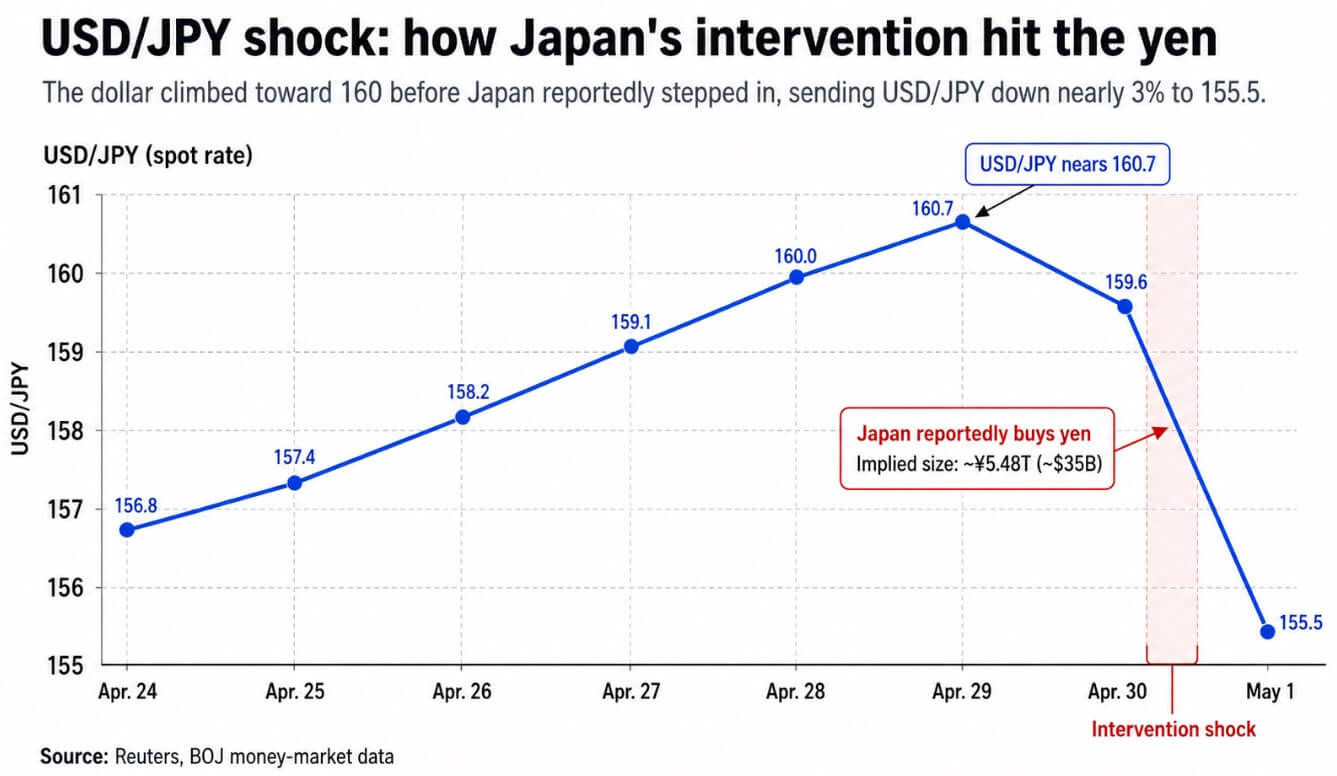 USD/JPY peaked at 160.7 on April 29 before Japan's reported $35 billion intervention drove the pair down to 155.5.
The BOJ held its policy rate at 0.75% on Apr. 28, with three board members dissenting and arguing for a 1% rate. The Fed also held its policy rate at 3.50%-3.75% on Apr. 29.
That short-rate reality of roughly 275 to 300 basis points is the mechanical reason the carry trade keeps rebuilding. Yen borrowing costs stay low by almost any global comparison, and the spread to US yields makes it attractive to put that capital to work in higher-returning assets.
Intervention without rate convergence only buys time. Reuters reported that 65% of economists in an Apr. 16 poll expect the BOJ to reach 1.0% by the end of June 2026, with further hikes penciled in through 2027.
Why the yen is everyone's problem
BIS data from its 2025 triennial survey shows the yen accounted for 16.8% of all foreign exchange trades worldwide.
Another BIS study on the August 2024 episode estimated yen-funded carry trades at roughly $250 billion, before that unwind, while UBS estimated the total near $500 billion, with only about halfway done at the time.
A separate BOJ paper noted that yen liabilities fund balance sheet expansion is driven by hedge funds and financial intermediaries that are long assets far removed from Japanese currency markets.
CFTC positioning data from Apr. 21 shows leveraged funds in CME yen futures held 80,220 long contracts against 148,717 short contracts, with gross shorts up over 16,000 week over week.
When the yen suddenly strengthens, those shorts need coverage, and the assets those trades were funding need to be trimmed.
| Policy rate | 0.75% | 3.50%–3.75% | The wide gap keeps yen funding cheap and U.S. assets relatively attractive |
| Latest policy decision date | Apr. 28, 2026 | Apr. 29, 2026 | Shows the rate divergence is current, not historical |
| Current short-rate gap | Roughly 275–300 bps | This spread is the core mechanical driver of yen-funded carry trades | |
| Policy bias | Three BOJ board members dissented in favor of a 1.0% rate | Fed held steady | Suggests Japan may be moving slowly toward tighter policy, but not fast enough yet to erase the spread |
| Market expectation | Reuters poll: 65% of economists see BOJ at 1.0% by end-June 2026 | No comparable immediate shift in the draft | A BOJ hike could compress the carry spread and make short-yen positions less attractive |
| Carry-trade implication | Low-cost funding currency | Higher-yield destination market | Investors can borrow cheaply in yen and seek better returns elsewhere |
| Article takeaway | Intervention can jolt FX markets, but without rate convergence it only buys time | Higher U.S. yields keep the carry incentive alive | Explains why yen weakness keeps rebuilding and why a sudden yen rebound can squeeze risk assets, including Bitcoin |
BIS data also show that foreign-currency credit denominated in yen contracted by 4.9% during 2025, so the carry complex may already be somewhat smaller, which means the mechanical force of any unwind is lower.
Bitcoin's sensitivity runs through global leverage, as the balance sheets, margin calls, and risk appetites of the same macro funds simultaneously short yen and long higher-yielding assets.
BIS's August 2024 review found that procyclical deleveraging and margin increases amplified the shock across risk assets, and Bitcoin tanked 13% during the washout.
Bitcoin traded in the $78,000 zone on May 1, reaching an intraday high near $79,000. A sudden yen squeeze forces leveraged macro books to cut gross exposure, and traders can sell Bitcoin because it is liquid and held by leveraged books that need to raise cash fast.
The bull case
If the BOJ's three dissenters are right and a June rate hike lands, it will come with a credible tightening cycle that compresses the carry spread, makes a fresh buildup of short-yen positions less attractive, and the dollar softens with it.
The intervention already pushed the dollar index down 0.8%, with the euro, pound, and Swiss franc all gaining. That broad dollar softening is historically a constructive backdrop for Bitcoin, which tends to track global dollar liquidity.
In an orderly adjustment where the BOJ's June hike lands without triggering a disorderly unwind, USD/JPY settles into a tighter range, and global risk markets absorb the repricing without cascading margin calls.
Bitcoin can work through its initial volatility and return to the weaker-dollar, easier-liquidity regime that drove its rally through early 2024.
Coinbase Research's outlook for the second quarter noted that 75% of institutional respondents view BTC as undervalued at current levels, which argues that buying interest waits on the other side of any short-term dislocation.
An 8% to 15% recovery from current levels over a two-to-six-week window is a plausible outcome in this scenario.
The bear case
Repeated interventions, or a sharper repricing of BOJ policy expectations, could squeeze the short-yen trade with enough velocity to force VAR and margin cuts across macro portfolios simultaneously.
In that setup, traders sell Bitcoin because it is liquid and held by leveraged books under pressure.
The August 2024 analog serves as the reference frame, with roughly a 15% drawdown over a matter of days, driven by the same carry mechanics and amplified by forced selling.
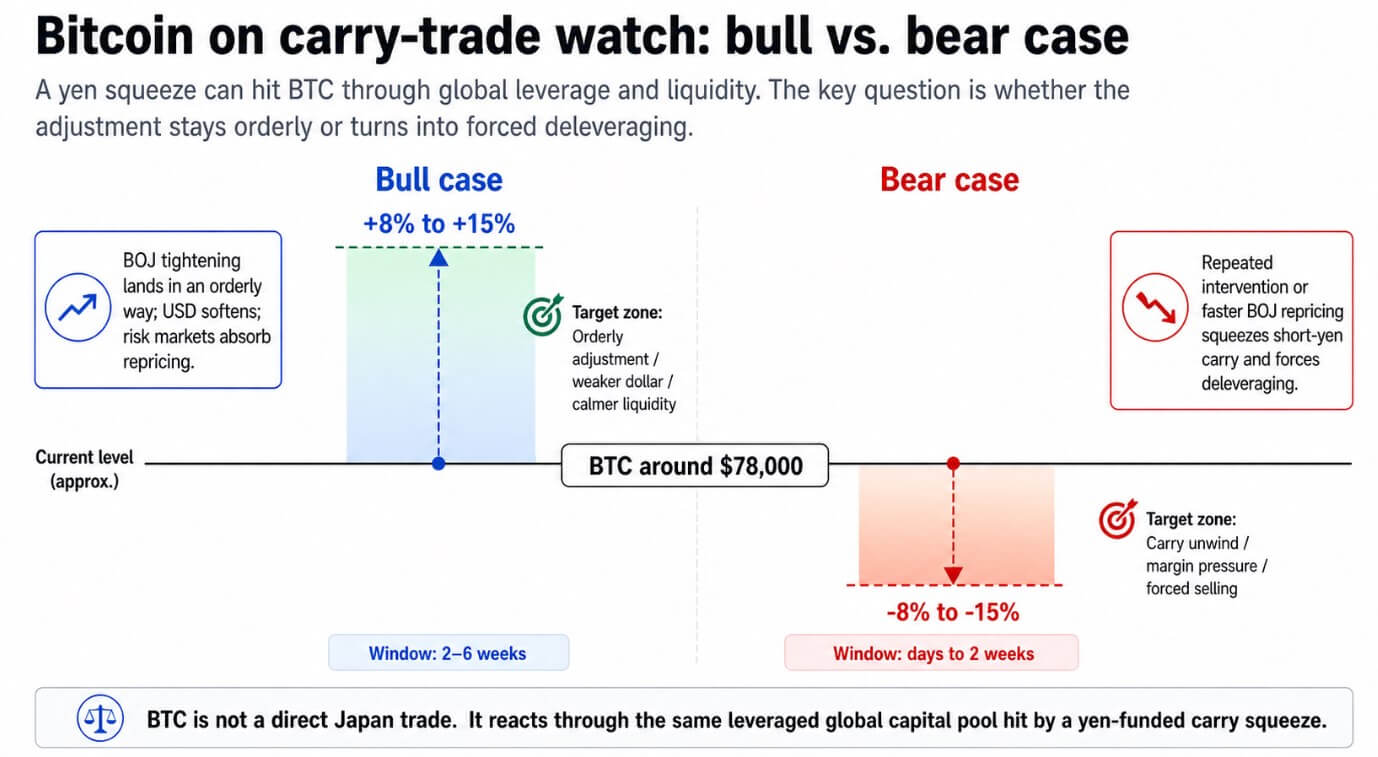 A yen-funded carry squeeze puts Bitcoin at risk of an 8–15% drawdown within days, or an 8–15% recovery over two to six weeks if the adjustment stays orderly.
Bitcoin sitting at the $78,000 zone presents less cushion for holders with large embedded gains who might sit through a dip.
A drawdown of 8% to 15% is consistent with historical patterns when interventions recur without policy backing.