 2 months ago
63
2 months ago
63
Bitcoin briefly recovered the $74,000 zone on May 29, absorbing a geopolitical signal that oil futures, ETF desks, and US equity traders won't fully process until Monday.
President Donald Trump said he would make a “final determination” on an Iran deal that would require the Strait of Hormuz to reopen for unrestricted traffic, with mines removed and tolls prohibited.
Iran responded that the agreement had not been finalized and that Trump's account was partly inaccurate.
While CME crude, US equities, ETF flows, and Treasury markets are either closed or less active, traders can still express Hormuz risk through BTC and 24/7 oil perpetuals on venues such as Hyperliquid.
That turns the weekend into another live test of Bitcoin markets functioning as the first layer of macro price discovery before traditional markets reopen.
The EIA logged 20 million barrels per day of oil flows through the strait in 2024, roughly 20% of global petroleum liquids consumption, and the IEA separately noted that around 25% of global seaborne oil trade transited the route in 2025.
Middle East crude exports have collapsed from about 18.3 mb/d before the crisis to roughly 8.8 mb/d since March, prompting analysts to lift 2026 Brent forecasts to $90.44/bbl for a third consecutive time.
| Oil flows through Hormuz, 2024 | 20 mb/d | Around 20% of global petroleum liquids consumption |
| Share of global seaborne oil trade via Hormuz | ~25% | Chokepoint risk directly affects crude pricing |
| Middle East crude exports before crisis | 18.3 mb/d | Baseline supply flow |
| Middle East crude exports since March | 8.8 mb/d | Supply stress remains severe |
| 2026 Brent forecast | $90.44/bbl | Analysts still pricing elevated risk |
A credible Hormuz reopening lowers the oil-inflation-stagflation premium that has pressed on risk assets for months, while a disputed deal restores it before institutional crypto flows can respond.
BTC sits between $72,490 and $74,213, with resistance at $74,200-$75,000 carrying structural weight beyond psychology. Roughly $6.25 billion in BTC options expired on Deribit on May 29, with $75,000 as max pain and the largest put concentration at that level, and BTC expired below it.
With options expiry behind them, traders face a weekend with US spot ETF flows offline, which have been running decisively negative.
Farside Investors' data shows net outflows of $733.4 million on May 27 and $223.3 million on May 28. BlackRock's IBIT shed $527.84 million on Wednesday, its second-largest daily outflow since launch, and the 11 US spot BTC ETFs have lost more than $2 billion over the past two weeks.
Institutionally hollow
During the week, Bitcoin ETF flows, CME hedging, market makers, and macro traders absorb new information and keep prices anchored across venues.
On weekends, spot BTC continues trading, but in a thinner book, with fewer arbitrageurs to close cross-exchange gaps.
Kaiko found that after US spot ETF launches, Bitcoin weekend volume fell to an all-time low share of 16%, down from 28% in 2019, as ETF activity concentrated trading around US market hours.
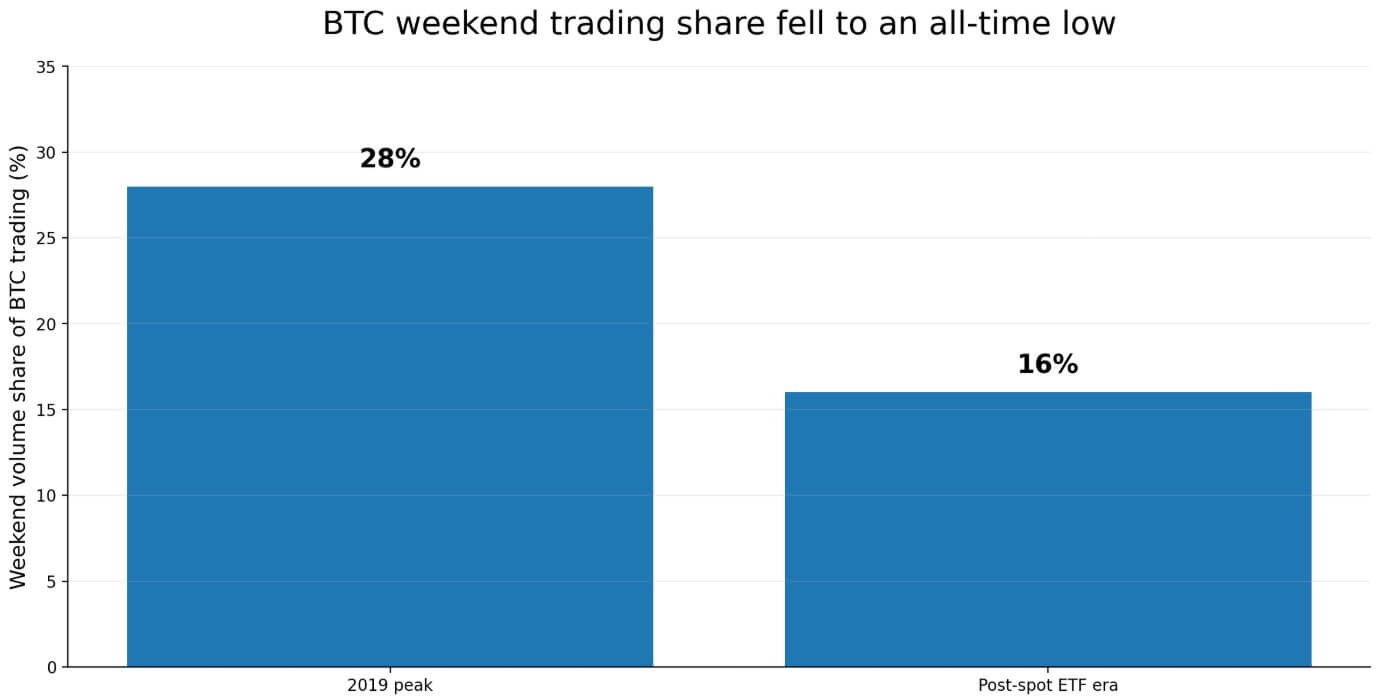 BTC's weekend volume share dropped from 28% in 2019 to a record-low 16% after U.S. spot ETFs launched.
In a January 2026 example involving XRP prediction markets, Kaiko showed that cross-exchange price dispersion, which is typically below 5 basis points on weekdays, spiked above 18 bps during weekend liquidity deterioration as reduced arbitrage activity allowed prices to drift apart across venues.
Bitcoin dropped over 6% on a Saturday during a liquidation wave, and Bitfinex analysts attributed the severity to thin weekend order book depth, which compressed the downside.
A 6% move from $73,500 implies roughly $69,000, inside the $67,000-$69,000 range that marked Bitcoin's last major floor before the ETF-driven recovery.
One range for two outcomes
If language from Tehran and Washington converges on mine-removal timelines, verified shipping lanes, or any sign that the deal has enforceable mechanics, the oil risk premium keeps falling, and thin weekend liquidity amplifies the move upward.
With fewer sellers and lighter books, a sentiment-driven squeeze above $74,200 can carry Bitcoin toward $75,000-$78,000, with $80,000 as a stretch target aligned with the large call concentration on Deribit.
A reclaim of $75,000 in thin weekend conditions would be a squeeze into the level Bitcoin failed to hold at options expiry. That is the structural thinness that compresses the downside works in reverse on the upside, with fewer sellers and lighter books amplifying any directional conviction.
If Iran's “not finalized” framing gains traction, if contradictions in the blockade-easing terms surface, or if any new tanker or security incident hits wires before Sunday futures open, Bitcoin prices the deal as performative rather than enforceable.
A break below $72,500 removes the floor that has held through two weeks of ETF outflows, with $71,000 as the next structural reference and $70,000 as the round-number sentiment line below that.
A sustained close below $70,000 would reframe the past month of Bitcoin consolidation as distribution ahead of a broader risk-off repricing when equities and rates reopen Monday.
| Upside squeeze | Washington and Tehran language converges; shipping or mine-removal timelines look credible | Break above $74.2K–$75K | Thin liquidity helps BTC price lower oil-shock risk before Monday |
| Range hold | No confirmation, no breakdown, no new tanker/security incident | $72.5K–$75K | Market waits for oil futures, ETFs, and equities to validate the signal |
| Headline fade | Iran’s “not finalized” framing dominates or deal terms appear contradictory | Break below $72.5K | BTC prices the claim as performative rather than enforceable |
| Risk-off break | Failed deal, security shock, or tanker incident | Below $70K | Weekend liquidation risk becomes the main signal into Monday |
The real contest
The IEA called the resumption of Hormuz the “single most important variable” for global energy supply and price relief in its April Oil Market Report, noting that early-April shipments through the strait had fallen to 3.8 mb/d from more than 20 mb/d in February.
BTC is now one trade ahead of every other major market in pricing whether that variable has actually changed.
A 48-hour window of thin liquidity, absent ETF flows, and an unconfirmed deal can produce a price signal that mainstream markets will spend Monday morning either validating or unwinding.
The prize Bitcoin traders are actually bidding on this weekend is whether a tentative claim about a strait that moves 20 million barrels a day holds up long enough for oil and equity markets to confirm it.