 10 hours ago
6
10 hours ago
6
Binance lowered the collateral ratio for six tokens on Sept. 18, while Coinbase International Exchange says 29 assets will leave its eligible-collateral list on Sept. 29. That ratio determines how much of an asset’s market value an exchange recognizes for borrowing or margin calculations.
The exchanges operate separate products and account systems, but both changes show how an affected token can keep the same market price while contributing less to a trader’s borrowing limit or margin cushion.
Binance’s Sept. 18 update cut collateral ratios for AUCTION, BLUR, GALA, HYPER, S and SYRUP from 30% to 10%. The same update raised ARB, TAO and WLD from 50% to 60%.
How exchange rules shrink usable token collateral
A hypothetical trader holding $100,000 of one of Binance’s six affected assets illustrates the change. A 30% collateral ratio gives the holding $30,000 of recognized collateral value, while a 10% ratio gives it $10,000.
The holding’s assumed market value stays at $100,000, while the amount the exchange recognizes falls by $20,000. The ratio falls by 20%, equivalent to a 66.7% relative reduction.
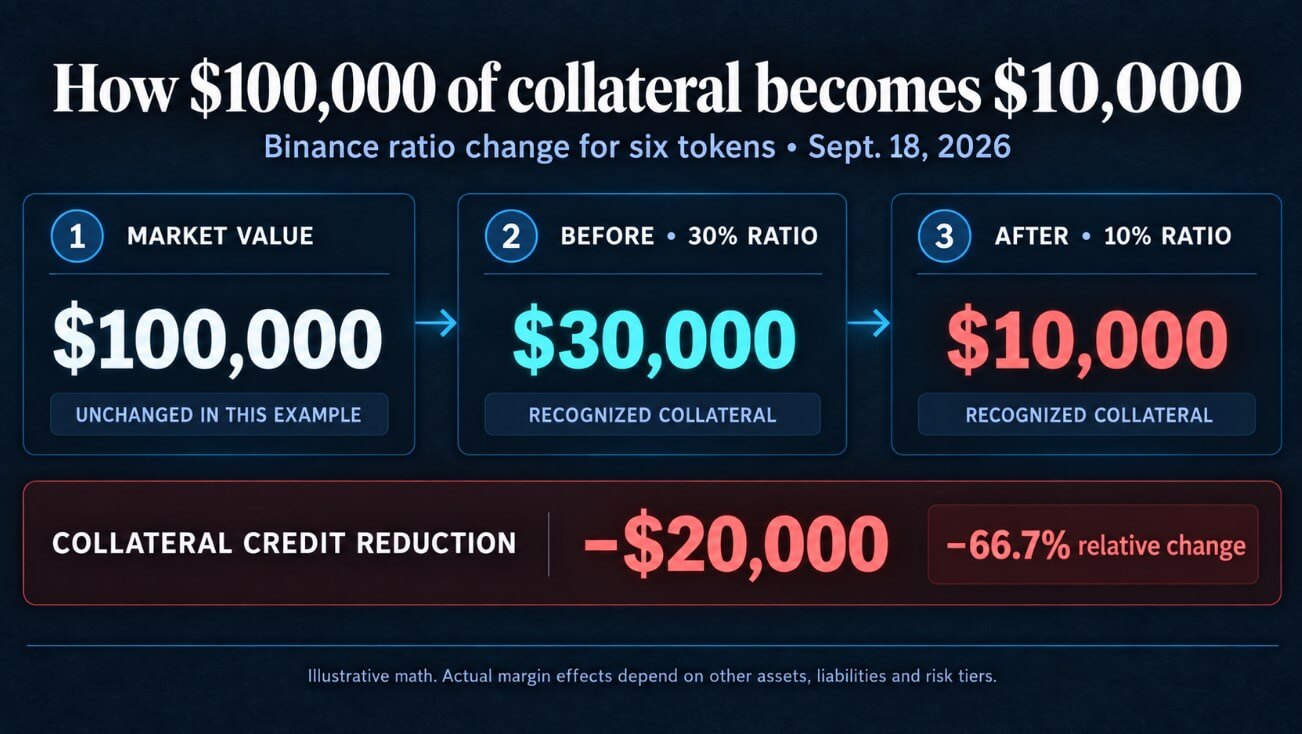 Binance’s collateral ratio reduction from 30% to 10% cuts recognized value on $100,000 of affected tokens from $30,000 to $10,000.
Binance said its Cross Margin change affects the amount a customer can borrow or transfer out. In Portfolio Margin, collateral ratios feed the unified maintenance margin ratio, or uniMMR, which measures whether the combined portfolio has enough margin to support its positions.
A lower recognized value can reduce that cushion, but the outcome depends on the account’s other assets, liabilities, and applicable risk tiers.
Coinbase International Exchange’s collateral page says 29 assets will no longer count as eligible collateral on Sept. 29. The list includes BNB, AVAX, ARB, ONDO, PEPE, SHIB, and UNI.
The notice changes collateral eligibility within Coinbase’s derivatives system. Customers whose accounts rely on those assets may need to add other collateral or reduce exposure, depending on their individual margin position.
SYRUP shows how quickly a venue can reverse an internal risk weight. Binance raised SYRUP’s ratio from 10% to 30% on Sept. 4, then returned it to 10% on Sept. 18, a total of 14 days apart.
Selective repricing sets the limits of the story
Binance adjusted higher ratios for ARB, TAO and WLD usage as collateral in the Sept. 18 update. A Sept. 11 change also raised ratios for tokenized gold and equity-linked assets, including PAXG, XAUT, QQQB and SPYB, while cutting seven cryptoassets.
Those mixed changes support a conclusion of selective risk repricing within Binance’s system. Aggregate borrowing capacity could rise or fall depending on the balances held in each asset.
A report by Glassnode and Bybit said coin-margined collateral lost the majority of the tracked Bitcoin futures book and never regained it. Coin-margined positions expose a trader to a losing contract and weakening collateral during the same market move.
That report describes a longer-running shift in Bitcoin derivatives market structure. The September notices address current rules at Binance and Coinbase, and the available evidence shows no link indicating the exchanges coordinated their decisions.
Binance also removed five cross-margin pairs on Sept. 18: ENJ/USDC, GENIUS/USDC, CVX/USDC, GUN/USDC and VANA/USDC. It removed the GENIUS/USDC isolated-margin pair and automatically settled remaining positions.
The next measurable effects would appear in pledged collateral, borrowing utilization, margin calls, position reductions, or liquidations.
Exchange disclosures covering those figures would show whether the parameter changes caused material deleveraging. For now, the notices demonstrate that exchange-set collateral rules can tighten usable leverage independently of token prices.