 1 month ago
54
1 month ago
54
Europe’s crypto rulebook is squeezing much of the industry before it has even fully taken effect, with Binance and Tether as the most visible examples of a wider scramble to remain within the bloc’s regulated market.
The pressure is building ahead of the July 1 deadline for firms to secure authorization under the European Union’s Markets in Crypto-Assets regulation, known as MiCA.
Alex Obchakevich of Obchakevich Research said only 194 of more than 3,000 crypto companies operating in Europe have obtained a license, leaving exchanges, brokers and wallet providers at risk of losing access to EU users once the transition period ends.
Obchakevich said 60% of European crypto users still rely on unlicensed platforms, while 7.6 million of the 18.5 million recent app downloads in the region were from firms without authorization.
That raises the prospect that the deadline could disrupt crypto access for millions of users before compliant alternatives have fully absorbed the market.
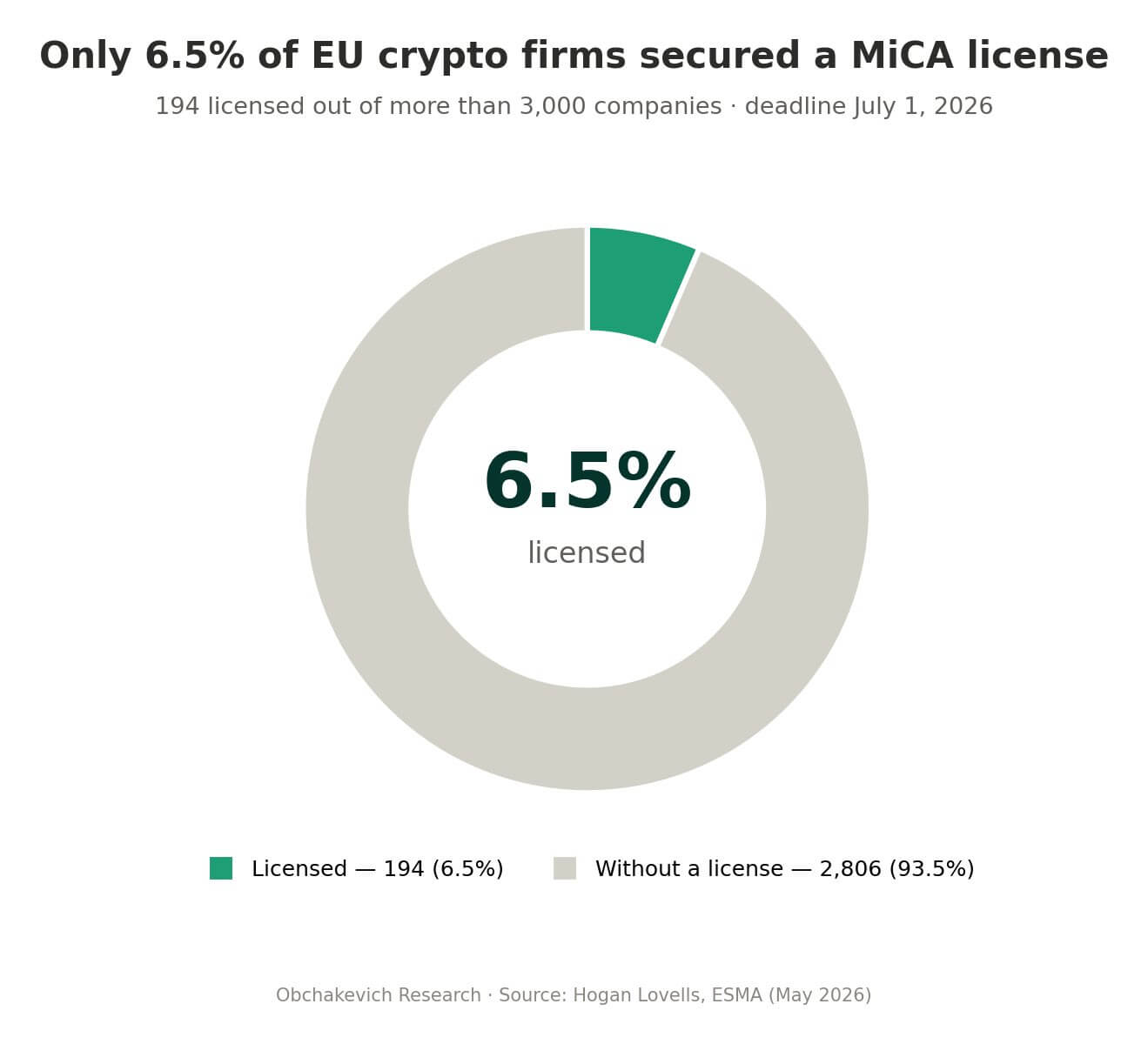 Crypto Companies Compliance With EU's MiCA Regulations (Source: Obchakevich Research)
The squeeze also comes as the European Central Bank presses lawmakers to advance the legal framework for a digital euro.
That timing has turned MiCA into more than a licensing exercise, because the regulation is beginning to determine which companies can distribute digital assets across Europe, which stablecoins can circulate on regulated venues and how much room private crypto firms will have before a public digital-money alternative enters the market.
Binance’s MiCA European route narrows
Binance’s MiCA strategy had centered on Greece, where the exchange applied for a license earlier this year after establishing a local holding company in Athens.
An approval would have allowed the company to use the bloc’s passporting system to serve customers across all 27 EU member states from a single regulatory base.
However, that route now appears at risk.
Reuters reported that Greece’s Hellenic Capital Market Commission is preparing to reject Binance’s application, citing people familiar with the matter. If confirmed, the decision would leave Binance without a clear MiCA authorization just days before the July 1 deadline.
The reported setback has attracted wider attention because of claims that the decision may have extended beyond a standard regulatory review.
Gareth Jenkinson, head of multimedia at The Block, said he was told ECB President Christine Lagarde intervened after Greek regulators had effectively completed their assessment of Binance’s application. Neither the ECB nor Greek authorities have confirmed that account.
Even without official confirmation, the claim has added to industry debate over how much Europe’s crypto licensing process is being shaped by broader monetary and financial-stability priorities as MiCA takes full effect.
Despite the situation, Binance has maintained that its European strategy remains intact. Co-Chief Executive Richard Teng said the company remains committed to securing MiCA authorization and continuing operations under what he described as a “clear, fair, and harmonized” regulatory framework.
The firm is now exploring an alternative path through France, according to The Big Whale. The exchange already holds a digital asset service provider registration with France’s market regulator, allowing limited activities such as custody and spot trading. A full MiCA license there would restore its ability to operate across the bloc under the same passporting framework.
USDT retreats from EU licensed venues
On the other hand, Tether, the largest stablecoin issuer, faces a separate but related MiCA issue.
The EU framework requires issuers of fiat-backed stablecoins to register as electronic money institutions and comply with reserve, governance and disclosure rules.
Tether Chief Executive Paolo Ardoino has repeatedly criticized those requirements, especially rules governing how reserves must be held, and has said the company does not plan to seek approval in the EU for now.
That decision has already changed the market structure for European users.
Major exchanges, including Binance, Coinbase, Kraken, OKX, Bitstamp, and Crypto.com, have removed or restricted USDT for EU customers. Circle’s USDC, by contrast, has secured MiCA compliance, making it the only major dollar-backed stablecoin widely available across licensed EU platforms ahead of the deadline.
However, Tether has not abandoned Europe entirely.
The company invested in Dutch fintech Quantoz to support the launch of EURQ and USDQ, stablecoins designed to comply with European rules. Quantoz operates under the supervision of the Dutch central bank, and the tokens are structured as e-money products.
That move gives Tether a regulated foothold in Europe even as USDT, its core product, becomes harder to access through licensed venues.
The shift also strengthens a wider point for policymakers. Europe is not only asking stablecoin issuers to follow new rules. It is forcing the market to decide whether liquidity should remain concentrated in offshore dollar tokens or move toward regulated issuers operating inside the bloc.
The digital euro gives the dispute a larger frame
The pressure from Binance and Tether comes as the ECB continues to argue for a digital euro, a central bank-issued digital currency intended to complement cash and strengthen Europe’s payments sovereignty.
Lagarde has repeatedly urged lawmakers to accelerate the project, describing it as important to Europe’s monetary autonomy.
ECB Executive Board member Piero Cipollone recently told the European Parliament that the digital euro could support innovation, reduce fragmentation in payments and improve resilience in an uncertain global environment.
The ECB says a pilot could begin in 2027 if legislation is adopted in 2026. The Eurosystem could then be ready for a possible first issuance in 2029.
That timetable places Europe in a transitional period. The digital euro remains years away, but the private digital-money market is being reshaped now.
The ECB’s April 2026 Macroprudential Bulletin showed euro-denominated stablecoins had grown to about €450 million in January from €50 million two years earlier. Dollar-denominated stablecoins, by comparison, stood near $300 billion.
The gap explains why European officials are sensitive to stablecoin growth. A large share of crypto liquidity still runs through dollar-linked tokens issued outside the eurozone.
For the ECB, that raises questions about monetary control, financial stability and dependence on non-European payment rails.
Binance sits near the center of that system because large exchanges distribute stablecoins, set liquidity conditions and determine which assets European users can access. Tether sits at the other end as the dominant private dollar instrument used across crypto markets.
That combination makes the MiCA deadline a test of Europe’s preferred digital-money order before the digital euro is ready.

Europe’s crypto market enters a narrower phase
The July 1 deadline could leave European users with fewer global platforms, fewer stablecoin options and a clearer divide between regulated and unregulated crypto services.
For Binance, the immediate question is whether France can provide a viable path if Greece rejects its application. For Tether, the question is whether USDT can remain relevant to European users after disappearing from the region’s licensed venues.
For the ECB, the moment strengthens the case for a sovereign digital-money alternative.
The broader outcome may take years to measure. MiCA gives Europe a rulebook before the digital euro arrives. That rulebook is already deciding which private companies can operate at scale.
By the time the ECB is ready to issue a digital euro, Europe’s crypto sector may already be built around a smaller group of licensed exchanges, compliant stablecoin issuers and payment firms operating closer to the traditional financial system.
That would mark a major break from the offshore market structure that shaped crypto’s first decade and give Europe more control over the rails through which digital money moves.