 1 month ago
56
1 month ago
56
On June 10, administration officials hosted law enforcement groups at the White House to resolve the provision most likely to block the CLARITY Act from reaching the Senate floor for a vote.
As Eleanor Terrett reported, the meeting drew around 20 attendees over nearly 90 minutes, with developer protections drawn from the Blockchain Regulatory Certainty Act (BRCA) dominating the agenda.
Section 604 of the Senate draft defines a “non-controlling developer or provider” as one lacking the legal right or unilateral ability to control, initiate, or effectuate user transactions without another party's approval.
Under that definition, the provision limits money-transmitter treatment to parties who actually control or move assets, leaving developers who write distributed-ledger software, provide self-custody tools, or support blockchain infrastructure outside that classification.
| Open-source software developer | No | Likely yes | Writing or publishing code alone would not trigger money-transmitter status. |
| Self-custody wallet provider | No | Likely yes | User controls private keys; provider does not move funds for the user. |
| Node, oracle, or infrastructure provider | No | Likely yes | Supporting blockchain infrastructure is treated differently from operating a financial service. |
| Front-end operator with admin keys or transaction control | Possibly | Unclear / fact-specific | This is where compromise language may narrow the safe harbor. |
| Exchange, broker, dealer, or hosted wallet | Yes | No | These actors intermediate customer activity and remain inside the compliance perimeter. |
| Developer knowingly facilitating illicit transfers | Not the only issue | No safe harbor if criminal intent applies | Industry argues criminal liability survives where there is knowing facilitation. |
Where law enforcement draws the line
Cortez Masto, in her statement following the Senate Banking vote, said the current version of the CLARITY Act “undermines law enforcement's ability to trace illicit finance and recover victims' money, while at the same time creating a more challenging environment to prosecute criminals for knowingly transmitting illicit funds.”
Her amendments targeting decentralized platform enforcement were ruled out of order during the markup before Chairman Tim Scott later reinstated several others.
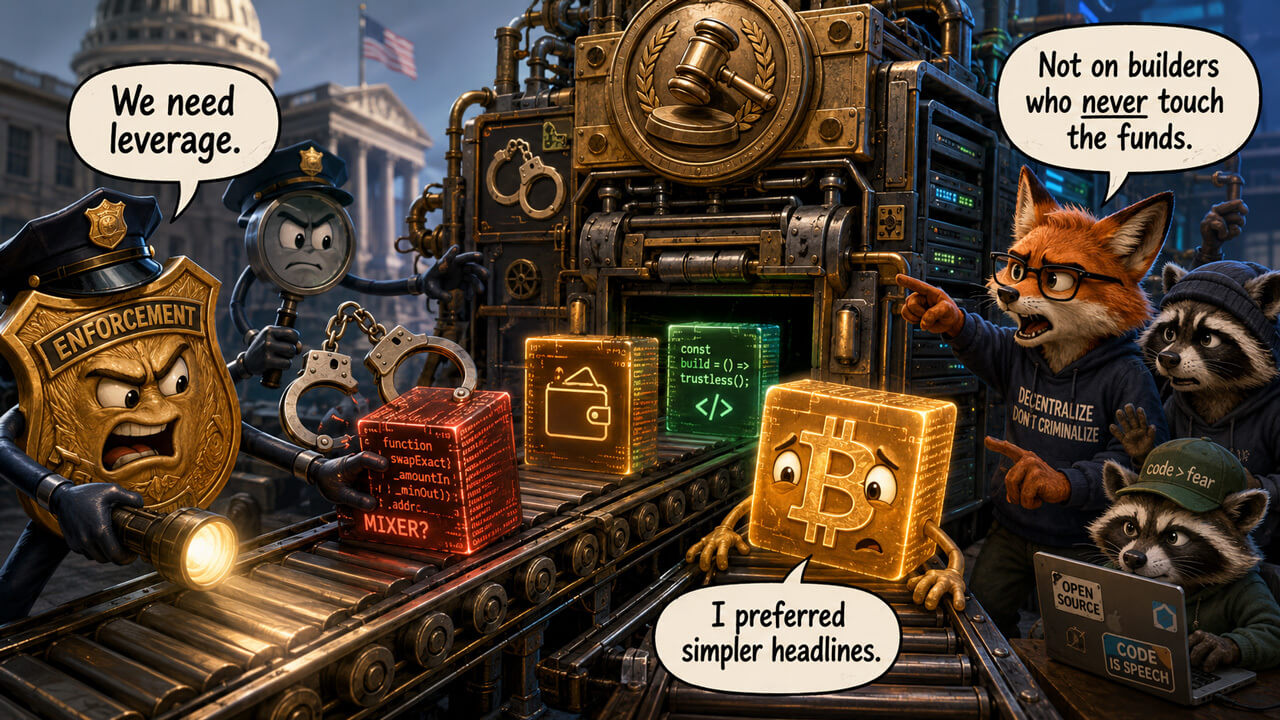
In an April 21 letter to Senate Banking leadership, the Fraternal Order of Police (FOP) said Section 604 would limit prosecutors' ability to pursue financial crime cases involving cryptocurrency, arguing that the safe harbor could strip law enforcement of statutes used to prosecute criminals operating on digital asset infrastructure.
The fear is prosecutorial: that broad safe-harbor language gives criminals a structural shield by protecting the layers of infrastructure prosecutors currently use as pressure points.
TRM Labs estimated illicit crypto volume reached $158 billion in 2025, up nearly 145% from 2024, while the FBI's 2025 Internet Crime Report found cryptocurrency investment fraud alone generated $7.2 billion in reported losses.
The industry's counterargument
White House crypto adviser Patrick Witt called the CLARITY Act a “pro-regulatory, pro-enforcement bill” during a Blockchain Association town hall, pushing back against law enforcement groups who argue the bill falls short on financial crime.
A coalition supported by the Blockchain Association submitted a letter signed by 160 former law enforcement, intelligence, and national security officials, arguing that the legislation would improve oversight through expanded sanctions tools, greater coordination with Treasury, and updated asset-seizure powers.
TRM Labs documented the bill's architecture, divided into:
| Title II | Applies BSA, SAR, and OFAC-style obligations to digital commodity brokers, dealers, and exchanges. | Centralized crypto market intermediaries. | Brings more crypto activity into AML, sanctions, and suspicious-activity reporting frameworks. |
| Section 203 | Creates a five-year public-private information-sharing pilot. | Treasury, law enforcement, regulators, exchanges, analytics firms, and other private-sector participants. | Gives investigators and compliance teams a formal channel to share illicit-finance intelligence. |
| Section 305 | Preserves temporary hold authority. | Digital asset service providers and stablecoin issuers. | Allows suspicious transactions to be paused before funds move beyond recovery. |
| Section 308 | Mandates blockchain analytics tools in certain compliance contexts. | Covered digital asset firms and intermediaries. | Turns blockchain tracing and risk monitoring into part of the statutory compliance toolkit. |
| BRCA / Section 604 | Limits money-transmitter treatment for non-controlling developers and providers. | Developers, self-custody providers, and infrastructure operators without control over user assets. | Protects software builders while leaving controlled intermediaries and knowing bad actors exposed. |
TRM also argues that criminal liability for knowing facilitation of criminal proceeds survives BRCA under 18 USC § 1960(b)(1)(C). The safe harbor covers non-controlling developers, and knowing participants in illicit finance retain full criminal exposure under existing statute.
The industry's core pitch is that regulated, US-based markets give investigators better visibility than developers pushed offshore by legal uncertainty.
The vote math
Warner and Cortez Masto have tied their floor votes to law enforcement's satisfaction with the final text.
The bill needs 60 Senate votes, requiring at least seven Democrats beyond the two who voted yes in committee. Gallego and Alsobrooks, who supplied the decisive committee votes, have conditioned floor support on further movement on ethics and enforcement.
Senate lawmakers working to reach an ethics agreement came away empty-handed this week.
The Senate has just 31 session days remaining before the August recess, which lawmakers and lobbyists view as the unofficial deadline before Congress turns its focus to midterm elections.
Stifel's chief Washington policy strategist, Brian Gardner, noted that if the Senate fails to act before August, the bill's prospects will deteriorate materially.
DeFi Education Fund confirmed BRCA is among the most important provisions for developers and infrastructure providers, and the bill's developer constituency depends on it surviving intact.
The more plausible path runs through a clearer intent or knowledge standard restricting the safe harbor to developers with no knowing involvement in laundering, tighter language around “non-controlling” status for front-end operators, relayers, or parties holding admin keys, and a savings clause stating explicitly that BRCA preserves criminal prosecution authority for knowing facilitation of illicit finance.
Each of those additions gives Senate Democrats a floor-defense line while keeping the provision's core protection for non-controlling developers intact.
Two ways this ends
In the bull case, law enforcement groups move from active opposition to neutrality, a lower bar than endorsement but sufficient political cover for Warner, Cortez Masto, and the remaining Democrats needed to reach 60.
A narrowed BRCA survives alongside strengthened reporting, analytics, and intent requirements, the bill reaches the floor before August, and developers keep the core protections, prosecutors keep the criminal carve-out, and the US gets its first comprehensive digital asset market structure law.
In the bear case, the gap between law enforcement's demand for prosecutorial flexibility and the industry's demand for developer protection proves unbridgeable before the calendar closes.
An accord among Senate lawmakers to resolve the ethics debate collapsed this week, and the bill misses the August recess deadline.
Regulatory uncertainty extends into 2027 and beyond, with enforcement-by-interpretation holding as the framework and offshore venues retaining structural advantages over US-based operators.
The odds on Polymarket of a CLARITY Act approval this year have moved from 74% to 48% over the past month, reflecting both risks being priced in simultaneously.
| Bull case: cops move to neutral | Law-enforcement groups accept revised language preserving prosecutorial tools. | BRCA survives with clearer intent, knowledge, and savings-clause language. | Moderate Democrats get enough cover to move toward 60 votes. | U.S. market-structure clarity becomes plausible in 2026. |
| Base case: talks continue, clock tightens | Negotiators narrow BRCA but do not fully satisfy law enforcement or developer groups. | Developer protections remain, but front ends, relayers, and admin-key operators face tighter language. | Vote math remains possible but fragile. | Markets price uncertainty; U.S. firms delay compliance and product decisions. |
| Bear case: gap remains unbridgeable | Law-enforcement groups keep objecting while ethics talks also stall. | BRCA becomes a floor-vote liability. | Democrats withhold support; bill misses the pre-August window. | Enforcement-by-interpretation continues into 2027; offshore venues retain an advantage. |
The political test for moderate Democrats is whether developer protections and prosecutorial tools can coexist in the same bill, and whether they can defend that answer on a Senate floor in a midterm year.
Warner and Cortez Masto have made their votes contingent on law enforcement's satisfaction, setting the threshold at neutrality.
A statement from the FOP that revised language adequately preserves prosecutorial tools may well clear that bar. Whether the June 10 meeting moved the conversation that far will be revealed by next week's Senate negotiations.