 7 hours ago
2
7 hours ago
2
Bitcoin has climbed back from its June 30 low near $58,500, trading at near $66,000 as of press time.
Options traders are still paying steep premiums for protection against another leg down, and traders on perpetual futures markets have resumed paying to hold leveraged long positions.
Both readings sit in a middle zone, well short of the extremes that marked past Bitcoin bottoms. The setup describes a market with enough optimism to rebuild leveraged exposure and enough fear to keep hedges expensive, a pre-capitulation trap sitting between recovery and capitulation.
The price of protection
One-month put options on Bitcoin, contracts that pay off if the price falls, now cost far more than equivalent call options, which pay off if the price rises.
VanEck's ChainCheck tracks that gap as a skew reading, and it widened from 9.8 percentage points to 11.4 over the past month, the 83rd percentile of any reading since 2021.
One-month call volatility sits near 35.5%, close to the bottom of its range since 2021, and put volatility sits far higher, at 46.9%. The gap shows traders assigning a price to downside risk, separate from any broad increase in expected volatility.
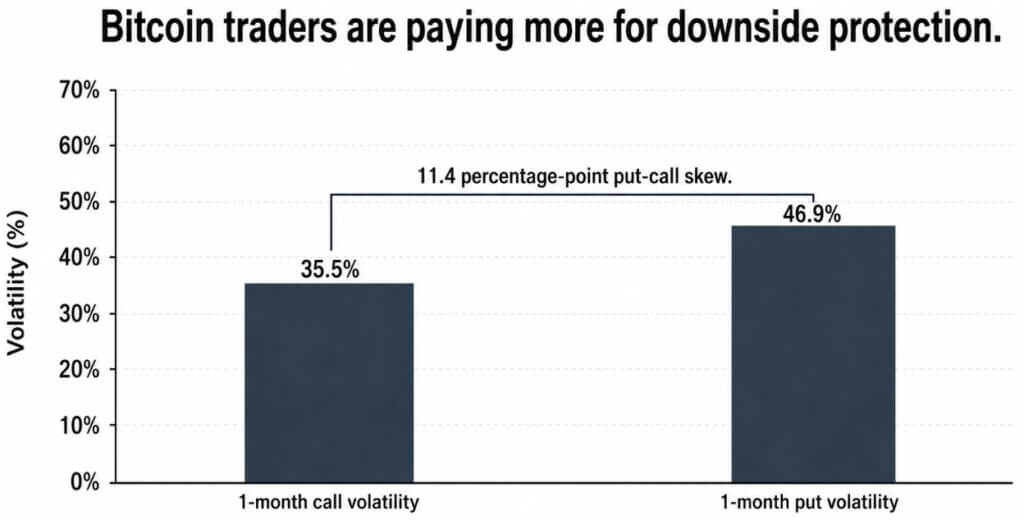 Chart shows one-month Bitcoin call volatility at 35.5% versus put volatility at 46.9%, an 11.4 percentage-point skew favoring downside protection.
Traders holding those puts face a decision once the June low is tested again: keep paying the elevated premium, or remove the hedge and trust the rebound.
VanEck sorts past skew readings into bands and tracks what happened next. Readings between 10 and 15 points, where Bitcoin sits now, produced a median 30-day return of 1.4%, a 90-day return of negative 8.8%, a 180-day return of 15.3% and a 365-day return of negative 19.1%.
Readings above 15 points, a more extreme fear level, produced stronger results over the 90-day, 180-day and 365-day windows.
VanEck frames that 15-point level as a marker drawn from its own historical dataset, describing what typically followed similar readings in past cycles.
Long positions rebuild early
Perpetual futures funding, the periodic payment leveraged long positions make to short positions, ran negative through most of the spring and has turned positive again this month.
The 30-day annualized rate now sits near 4.5%, well below Bitcoin's long-run average funding level. Leveraged long demand has returned, with positioning still lighter than the crowding seen before past selloffs.
Traders who bought Bitcoin during the last stretch of negative funding, from April 13 to May 23, paid an average of about $77,900. VanEck's July data cutoff put them roughly 20% underwater, the rare case where a historically reliable entry signal came up short.
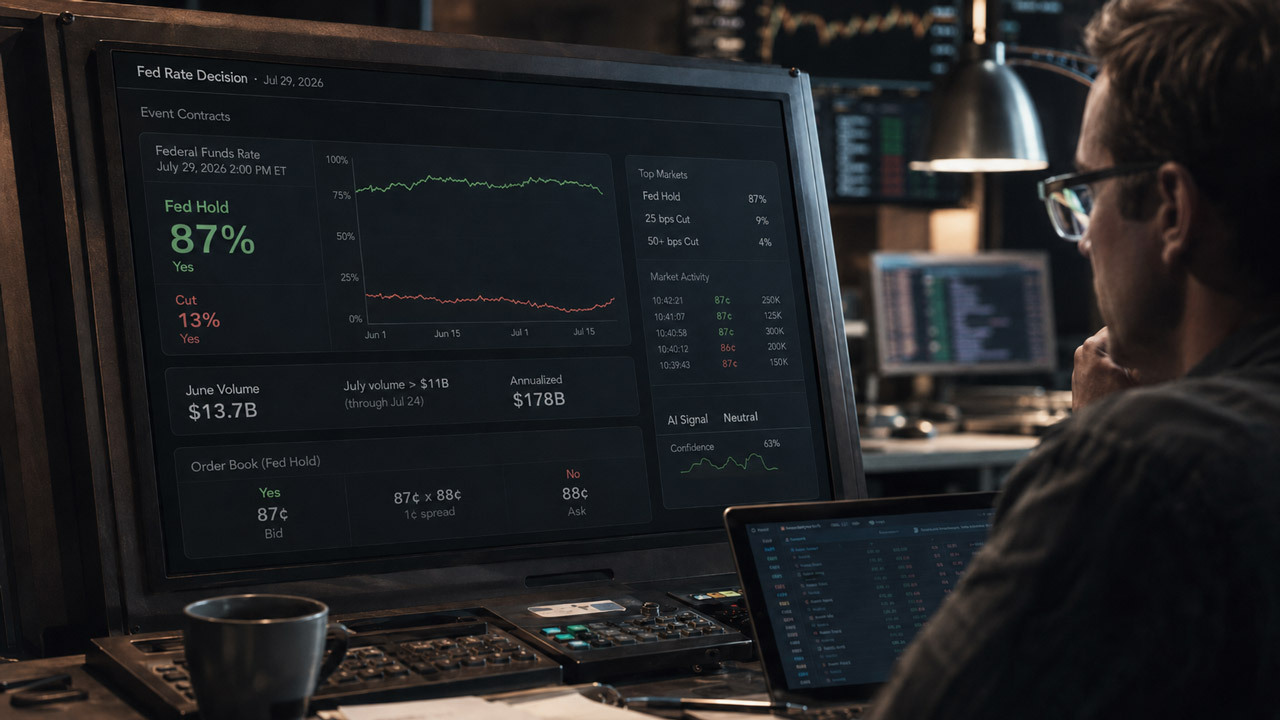
The Federal Reserve's next policy meeting runs July 28 and 29, with the rate decision due on the 29th. A Reuters poll of 104 economists conducted July 17 through 21 found unanimous expectation for a hold at 3.50% to 3.75%, so the market has largely priced in the headline outcome already.
Bitcoin's reaction to the statement and the press conference that follows will show whether the rebound has enough strength to hold.
Spot volume has averaged about $5.1 billion a day, below its longer-term average, in a month that serves as the macro test for a year that opened with a steep first-half drawdown, pressured by ETF selling and Fed uncertainty.
US-traded spot Bitcoin ETPs shed roughly 40,010 BTC over the past 30 days, and early July flows only turned slightly positive. A rally built on that kind of participation has room to prove itself once the meeting passes.
| Bitcoin price | Near $66,000 after June 30 low near $58,500 | Price has rebounded | Recovery in price does not prove positioning has reset. |
| 1-month put-call skew | 11.4 percentage points | Downside protection remains expensive | Fear is elevated, but not at VanEck’s >15 pp extreme-skew zone. |
| 30-day perp funding | Around 4.5% annualized | Leveraged longs are paying again | Long exposure is rebuilding before a clear capitulation signal. |
| Negative-funding buyers | Entry near $77,900, roughly 20% underwater | Prior “bottom” signal failed | Dip buyers still need a much larger recovery to break even. |
| Spot volume | Around $5.1B daily average | Participation is below longer-term average | The rebound still needs stronger spot confirmation. |
| Spot Bitcoin ETP flows | Roughly 40,010 BTC shed over 30 days | ETF demand has not fully recovered | Weak flow support makes the rally more vulnerable to macro disappointment. |
| Fed meeting | July 28–29 | Near-term catalyst | The headline hold is priced, but the reaction to guidance can still move BTC. |
Sizing the outcomes
In the bull case, Bitcoin holds its gains through the Fed meeting and spot demand strengthens enough to absorb the ETP outflows of the past month.
Put-call skew compresses toward the 5-point range as the cost of downside protection falls, and funding stays at a moderate, uncrowded level.
The June low starts to look like the cycle floor VanEck's historical bands would expect once a genuine reset takes hold.
In the bear case, the rebound stalls at the Fed meeting and leveraged longs built during the past month become the next liquidation risk. Funding flips negative again, put skew widens past 15 points as traders bid up protection further, and Bitcoin retests the June 30 low near $58,500.
| Bull case: rebound becomes a bottom | Bitcoin holds gains through the Fed meeting and spot demand strengthens. | Skew compresses toward 5 pp; funding stays moderate; ETP flows turn convincingly positive. | The June low starts to look durable. |
| Base case: trap persists | Bitcoin remains range-bound while hedges stay expensive and leverage rebuilds slowly. | Skew stays in the 10–15 pp band; funding remains lightly positive; spot volume stays soft. | The market has recovered in price, but not in conviction. |
| Bear case: failed rebound | Bitcoin retests the June 30 low near $58,500. | Funding flips negative; liquidations rise; put skew moves above 15 pp. | The rally becomes an intermission between selloffs. |
| Capitulation case: deeper reset | A macro shock or ETF outflows force a sharper flush before recovery. | Skew spikes above 15 pp; funding turns deeply negative; spot selling accelerates. | The market finally reaches the extreme fear VanEck associates with stronger forward returns. |
The dip buyers from April and May would need a much deeper recovery to break even, and the traders who removed their hedges too early would be doing so just as the market turned against them.
Bitcoin's price has already recovered, and the Fed meeting next week will answer whether its positioning has recovered too.